Why Does Baby Keep Turning Head While Nursing on One Side
Why attachment is important
A baby who attaches well to the chest can help forestall many breastfeeding problems. It's more than likely for breastfeeding to be comfy and for the babe to exist able to remove milk well from the breast. This helps ensure a good milk supply so the baby grows well.
Sore, grazed or croaky nipples usually mean your baby is non attached properly and has damaged your nipples. A poorly attached baby is not normally taking enough milk. This can pb to a blocked duct or mastitis.
Breastfeeding — natural just also learned
Breastfeeding, although natural, is also a learned skill. This is specially true in modern westernised civilisation.
All baby mammals have natural instincts which enable them to find their female parent's chest from birth with little or no assistance from anyone. These instinctive behaviours include:
-
sticking tongue out
-
turning head from side to side
-
wriggling
-
finding and grasping the nipple
-
latching-on to the breast
-
suckling.
These instinctive behaviours are seen as early as the commencement ane–2 hours afterwards nascence and continue for at least iii months after nascence. Sometimes a female parent's (and her infant's) instincts may be reduced past drugs used during the birth or by hospital procedures such as limited or delayed peel-to-skin time. Nevertheless, this tin exist overcome past a female parent and her baby spending as much fourth dimension equally possible together in peel-to-peel contact. A mother can be sure that she doesn't have to know it all and that her baby is born hardwired to breastfeed.
Baby-led attachment
'Baby-led attachment' is the term used to depict the process of a infant seeking out their mother's breast. Infant-led attachment offers your infant the most natural introduction to breastfeeding. Information technology is particularly helpful for babies who are reluctant starters. Here is a step-by-footstep guide to baby-led zipper.


Start with a calm infant (eg bringing your baby to your breast could assistance) . A calm baby is more than probable to be able to follow through on their instincts than a baby who is upset. Their tongue will exist down and forward which is where it needs to be to aid attain proficient zipper to the chest. If your infant does non calm by existence brought to your breast, yous could try to at-home your infant using other strategies (eg peel-to-skin contact or rocking).
Get to know your infant's feeding cues . Crying is a late feeding cue so it is important to recognise earlier feeding cues such as:
-
turning head from side to side
-
sticking tongue out
-
wriggling
-
putting hands to rima oris.
If your baby is upset, try the following to calm him:
-
skin-to-skin contact
-
stroking your baby's back in one management
-
talking to your baby
-
gentle rocking movements
-
letting them suck on your clean finger.
Skin-to-skin contact. Some mothers find being completely skin-to-skin with their baby helpful, ie not wearing a bra and baby in but a nappy. A female parent's body can help to regulate her baby'south temperature past changing her own breast temperature. Skin-to-skin contact also helps to regulate a babe's blood sugar levels and breathing and stabilise their centre charge per unit. Nevertheless, skin-to-skin is not essential at feeding fourth dimension if the mother feels more comfortable with both of them lightly dressed, equally long as the breast is available to the baby.
Positioning. A mother tin can agree her infant to her trunk in the way that feels right for her. Many mothers cull to hold their babe upright on their chest and between their breasts. Many mothers too find that a semi-reclined position works well. It is and so easier for a infant to make their own way to their mother'due south breasts, gently supported by their mother. It can likewise help to minimise nipple trauma, as it reduces the drag on a mother'south nipple that may occur when a mother is sitting upright.
When your babe is fix to feed, they will commencement to lift and bob their head effectually. Some babies will bob their fashion downward to a breast, others will gently glide towards a breast while others will quite dramatically throw themselves towards a chest. All these movements have a definite purpose — to find the breast!
Every bit your baby moves closer to your breast and nuzzles towards your nipple, they may bring their paw(s) to their oral cavity and begin to feel around with their fists and motion their head from side to side. Don't worry if they suck their fist. They volition shortly figure out that is not the chest. Some babies volition suck their fist to calm themselves. It's all part of the procedure. Don't hurry him. Let they practice it in their ain time.
When your baby finds your breast, they volition bring their tongue forrad and may lick at the breast. They may press into your breast with their fists and move their feet up and downward. Their movements help get the hormone oxytocin released in your encephalon, and in plow that helps get breastmilk flowing. Don't worry that it takes time in the early days, they will get more efficient with exercise.
When your baby finds just the right spot, t hey volition dig his chin into your chest, achieve up with an open mouth, attach to your chest and begin sucking. Let your infant lead the way equally much as possible. However, if sitting upward, some mothers notice information technology helpful to pull their infant's bottom closer in to their body, or to provide some firm back up to their baby's neck or shoulders while avoiding pushing on their baby's head. In a reclining position, gravity will human action on the babe's torso, making these actions by the mother unnecessary. A infant needs to take his head gratuitous to be able to position his head to latch on effectively.
A baby who has had many chances to seek out his mother's chest using their instincts, peculiarly in the early weeks, unremarkably apace becomes skillful at breastfeeding, no matter the position their mother chooses. After all, it is simply the baby who tin open their oral fissure wide, attach and begin suckling.
Breastfeeding positions
There are various means to position your baby for breastfeeding. There is no 1 right fashion for every female parent and baby. The right way is what works for y'all and your baby. Here are some steps which may help when you lot take the lead and bring your baby to your breast:
Steps to attach your infant
-
Sit comfortably with your back and feet supported.
-
Unwrap your baby and concur them close so that his chest is touching your chest. Do not concord their head.
-
Turn them onto his side with their chest towards you lot, head tilted slightly back, at the same level equally your breast. Their olfactory organ will be level with your nipple.
-
For some positions such as the cross cradle hold (encounter photos below), you lot tin support your baby's neck and shoulder blade with your hand. For other positions such every bit the cradle agree (see photos beneath) y'all tin support your babe's head in the cheat of your arm.
-
Gently castor your baby's mouth with the underside of your areola. Your baby should open his oral fissure wide when you do this. When your baby opens their rima oris wide and his tongue comes forward over their lower glue, bring him quickly to the breast with your nipple aimed at the roof of their mouth. Their first point of contact will be their lower jaw or chin, on your areola well down from the nipple.
-
As their mouth closes over the breast they should have in a large mouthful of breast.
-
If you are engorged , expressing to soften effectually the areola may allow them to attach more hands.
To check that babe is attached well, look for these signs:
-
Chin is pressed into the chest and nose is articulate or merely but touching the chest.
-
Lower lip flanged (turned out) over the chest. It is normal for the upper lip to rest in a neutral position at the breast.
-
Natural language is forrard over the lower glue (may exist difficult to see — don't pull them abroad to check or you might disassemble them).
-
Your babe has much of the areola in their mouth, more so on the 'chin side'.
-
In that location is no pain ( although information technology is common for new mums to feel nipple pain in the early on weeks as the baby attaches only this pain stops as the milk starts to flow ).
-
You may notice your baby's whole jaw moving as they suck and even their ears wiggling.
Photos of diverse breastfeeding positions
Cradle concur

Cross cradle agree

'Laid-back' breastfeeding

Straddle hold
Underarm (football) hold

Lying downwardly

If it hurts
-
Take your baby off the breast. Insert a clean little finger in the corner of their mouth to break the suction.
-
Nipples that are creased, ridged or squashed, blistered, cracked or bleeding mean the babe is not properly attached. They do not take the nipple far enough back in their rima oris and it is being squashed against their hard palate.
-
Wait for the baby to open up their rima oris broad and then reattach.
-
Sometimes a small change in the baby's position tin can aid. For instance, hugging the lower half of your babe'southward torso in, equally this helps to allow your infant's chin to further press into your breast. Ensure that there is no bunched clothing betwixt you or your infant's arm is getting in the way.
-
Chest to chest and chin to breast is a quick way of describing good positioning. Their whole torso should be very close to yours, like y'all are 'wearing' them.
Who to contact
If you accept any concerns about attaching your infant, please contact the Breastfeeding Helpline on 1800 mum ii mum (1800 686 268) to speak to an ABA counsellor. More detailed information is too available in the ABA booklets Breastfeeding: breast and nipple care and Breastfeeding: an introduction.
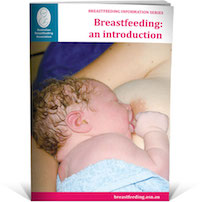 | Breastfeeding: an introduction booklet Breastfeeding: an Introduction provides a bones outline of the fundamental aspects of breastfeeding.  |
ABA website links
-
My breastfeeding plan (useful plan to read prior to your babe being built-in)
-
Positioning and zipper videos (including infant-led and laid-back breastfeeding)
Useful websites
http://www.biologicalnurturing.com
The data on this website does not replace advice from your health care providers.
Source: https://www.breastfeeding.asn.au/bfinfo/attachment-breast
Publicar un comentario for "Why Does Baby Keep Turning Head While Nursing on One Side"