Wi Will Never Be the Same Again I Will Keep Fighting Until the End
| "Boxing Weep of Liberty" | |
|---|---|
 Cover of the 1862 sail music for "Battle Weep of Liberty". | |
| Song | |
| Songwriter(s) | George Frederick Root |
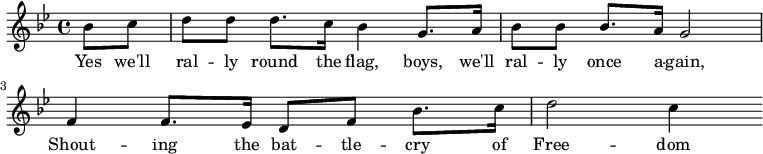
The "Boxing Weep of Freedom", also known equally "Rally 'Round the Flag", is a vocal written in 1862 past American composer George Frederick Root (1820–1895) during the American Civil War. A patriotic song advocating the causes of Unionism and abolitionism, information technology became and so popular that composer H. 50. Schreiner and lyricist W. H. Barnes adapted it for the Confederacy.[1]
A modified Matrimony version was used as the campaign song for the Lincoln-Johnson ticket in the 1864 presidential election, besides as in elections after the war, such as for Garfield in the 1880 U.Due south. presidential election.[2] The song was so popular that the music publisher had fourteen printing presses going at i time and withal could non keep upward with demand. It is estimated that over 700,000 copies of this song were put in apportionment. Louis Moreau Gottschalk idea and then highly of the vocal that in his diary he confided that he idea "information technology should exist our national anthem" and used it as the basis for his 1863 concert paraphrase for solo piano "Le Cri de délivrance," opus 55, and dedicated it to Root, who was a personal friend. Charles Ives quoted the song in several compositions, including his own patriotic song, "They Are There".[3]
History [edit]
"Boxing Cry of Freedom" proved popular among Union soldiers during the American Civil War. According to Henry Stone, a Union state of war veteran recalling in the late 1880s, the song helped the morale of Union soldiers:
A glee order came down from Chicago, bringing with them the new vocal, "Nosotros'll rally 'round the flag, boys", and it ran through the camp like wildfire. The issue was little brusk of miraculous. It put as much spirit and cheer into the army equally a victory. 24-hour interval and night one could hear it by every campsite fire and in every tent. I never shall forget how the men rolled out the line, "And although he may exist poor, he shall never be a slave." I do not know whether Mr. Root knows what expert piece of work his song did for us there, but I hope so.
—Henry Rock, The Century Illustrated, "Memoranda on the Civil State of war: A Song in Camp" (1887), emphasis added.[4]
According to historian Christian 50. McWhirter, the song's success and popularity among the Union was due to its fifty-fifty-handed references to both abolitionism and unionism. Thus, both groups of Unionists, those opposed to slavery and secession, could use the vocal without reservation:
The power of "The Boxing Weep of Freedom" to bridge divisions over emancipation is non surprising. The song's definition of the Northern cause is purposely open up-ended. Those looking for anti-slavery sentiments could find them, merely these elements were not so pronounced every bit to offend those who were solely unionists. The chorus was the primal, for information technology was there that Root described why Northerners rallied around the flag. The first line boldly endorsed a perpetual Marriage – "The Union forever" – followed past a potent dismissal of secession: "Down with the traitor, upward with the star." However, the battle weep Root shouted was i of "liberty." Freedom had many meanings in the Civil War – for example, liberty from Confederate political tyranny or the oft-perceived "slaveholders' conspiracy" – simply, in the context of Root'south political behavior and other activities, he clearly meant to suggest some degree of abolitionism.
—Christian L. McWhirter, The New York Times, "Nascence of the 'Boxing Weep'" (July 27, 2012).[5]
Lyrics (Union version) [edit]

"The Battle Cry of Freedom"
Oh nosotros'll rally round the flag, boys, we'll rally once again,[6]
Shouting the battle cry of freedom,
And we'll rally from the hillside, we'll assemble from the plain,
Shouting the boxing cry of liberty.(Chorus)
The Union forever, hurrah! boys, hurrah!
Down with the traitors, upward with the stars;[7]
While nosotros rally round the flag, boys, we rally once over again,
Shouting the battle weep of liberty!Oh we're springing to the call for iii hundred thousand more,[a]
Shouting the battle cry of freedom!
And nosotros'll fill the vacant ranks with a million freemen more,[viii] [9] [b]
Shouting the battle cry of freedom.(Chorus)
We volition welcome to our numbers the loyal, true and dauntless,
Shouting the battle cry of freedom!
And although he may be poor, he shall never be a slave,[c]
Shouting the battle cry of freedom!(Chorus)
And so nosotros're springing to the call from the Due east and from the West,
Shouting the battle cry of Freedom;
And nosotros'll hurl the rebel coiffure from the state we love the best,
Shouting the battle cry of Freedom.(Chorus)
Lyrics (Confederate version) [edit]
Our flag is proudly floating on the land and on the main,
Shout, shout the battle cry of Liberty!
Beneath information technology ofttimes we've conquered, and nosotros'll conquer oft again!
Shout, shout the boxing weep of Freedom!(Chorus)
Our Dixie forever! She's never at a loss!
Downward with the hawkeye and up with the cantankerous
While we rally 'round the Bonnie flag, we'll rally in one case again,
Shout, shout the battle cry of Freedom!Our gallant boys have marched to the rolling of the drums.
Shout, shout the battle cry of Freedom!
And the leaders in charge cry out, "Come, boys, come!"
Shout, shout the battle cry of Liberty!(Chorus)
They accept laid down their lives on the bloody battle field.
Shout, shout the battle cry of Freedom!
Their motto is resistance – "To the tyrants never yield!"
Shout, shout the battle cry of Freedom!(Chorus)
While our boys accept responded and to the fields have gone!
Shout, shout the boxing cry of liberty!
Our noble women besides accept aided them at home!
Shout, shout the battle cry of freedom!(Chorus)
Chorus (1864 election campaign) [edit]
For Lincoln and Johnson, hurrah, boys, hurrah!
Down with the rebellion and on with the war,
While we rally round the cause, boys, nosotros'll rally in our might,
Singing the holy cause of freemen..
In popular culture [edit]
- The vocal is sung past a marching unit of Matrimony infantry in the film The Undefeated (1969).
- Ry Cooder performed this song as "Rally 'Round the Flag" on his Boomer'southward Story album.
- The song is besides performed in The Long Riders (1980), with music produced by Cooder. In the moving picture, former Confederate irregular Clell Miller (played by Randy Quaid) confronts a musician playing this song, and forces him at gunpoint to play I'm a Practiced Ol' Insubordinate instead.[d]
- Eric Taylor has a live recording of this song as "Rally 'Round the Flag" on his Hollywood Pocketknife album in 2007.
- Keith and Rusty McNeil perform both the "Battle Weep of Freedom" and "Southern Battle Cry of Freedom" on Civil State of war Songs with Historical Narration (WEM Records, 1989, ISBN 1-878360-11-half-dozen).
- This song features prominently in Ken Burns' documentary The Ceremonious State of war, performed by Jacqueline Schwab.
- Billy Bragg wrote a vocal based upon the music of "Boxing Cry of Freedom" called "At that place Is Ability in a Matrimony" on the Talking with the Taxman about Poesy anthology. This song has different music and words than the song of the same name written by Joe Hill. For example, the chorus goes:
The Union forever defending our rights
Down with the blackleg, all workers unite
With our brothers and our sisters from many far off lands
There is power in a Union - Homer and Jethro (Henry Haynes and Ken Burns) released a 1967 parody called "The Ballad of Roger Miller" that used music from "Boxing Cry of Freedom" in the verses.
- Rally Round the Flag, Boys!, a 1958 motion-picture show, was based on a novel with the same title by Max Shulman, published in 1956.
- Indie rock band Titus Andronicus employ an adaptation of "Boxing Cry of Freedom" in "A More Perfect Union", the first song on their Civil War-themed 2010 anthology The Monitor. The altered verses include references to Jefferson Davis, the Amalgamated leader, and abolitionist John Brown.
- Film composer John Williams, in his score for the 2012 Steven Spielberg film, Lincoln, used an excerpt from "The Battle Weep of Liberty" in the track "Call to Muster and Battle Cry", with vocals performed by the Chicago Symphony Chorus and music performed by the Chicago Symphony Orchestra. The vocal is also sung by Republican members of the Business firm of Representatives to celebrate passage of the 13th Amendment.
- Elvis Costello sang and played the last lines of the song in the Two and a Half Men episode, "Back Off, Mary Poppins".
- The song is played at the dedication of the Hill Valley Courthouse (clock tower) in Dorsum to the Futurity Part Three (1990).
- The song is sung during the opening credits of the 1939 film Young Mr. Lincoln starring Henry Fonda and directed by John Ford.
- The vocal is sung by Miriam Hopkins in the 1940 moving picture Virginia City.
- The vocal with possible lyrics from Republic of ireland was sung past The Irish Rovers in Episode one of Season 7 of The Virginian (TV series).
See also [edit]
- Battle cry
- The Battle Hymn of the Republic
References [edit]
- ^ McIvor, James (October 31, 2006). God Rest Ye Merry, Soldiers: A True Civil War Christmas Story. Penguin. ISBN978-1-4406-2731-6.
- ^ Millard, Candice (2011). Destiny of the Republic. p. seventy. ISBN9780767929714.
- ^ Sinclair, James B. (1999). A Descriptive Catalogue of the Music of Charles Ives. Yale University Press. pp. 518–520. ISBN9780300076011.
- ^ Rock, Henry (1887). "A Song in Military camp". Memoranda on the Civil War. The Century Illustrated. Retrieved September iv, 2015.
- ^ McWhirter, Christian L. (July 27, 2012). "Nascence of the 'Boxing Cry'". The New York Times. New York. Retrieved September 4, 2015.
- ^ Silverman, Ballads and Songs of the Civil State of war, p. 8
- ^ "CONTENTdm". digital.library.temple.edu.
- ^ "CONTENTdm". digital.library.temple.edu.
- ^ Pen-pictures of the War: Lyrics, Incidents, and Sketches of the Rebellion; Comprising a Choice Option of Pieces by Our Best Poets, Likewise, Current and Well Authenticated Anecdotes and Incidents of the War. Together with a Full Account of Many of the Great Battles, Likewise, a Complete Historical Record of All Events, Both Civil and Military, from the First of the Rebellion. C.A. Alvord. March xxx, 1864. p. 98 – via Net Archive.
ranks with a million freemen more..
- ^ jhu.edu. Accessed 2022 March 21.
Notes [edit]
- ^ This line is sometimes given equally: "We are springing to the call of our brothers gone earlier."
- ^ This line is sometimes given equally: "And we'll fill the vacant ranks of our brothers gone before."
- ^ This line is sometimes given as: "And although they may be poor, non a man shall be a slave."
- ^ This is probably an anachronism, every bit the latter vocal was non copyrighted until 1915, well later on the scene in question, presumably in the 1870s. An edition of the canvas music of "The Expert Old Rebel" is "RESPECTFULLY DEDICATED TO THE HON. THAD STEVENS", who died on August 11, 1868.[ten] An entry in a 1910 edition of Library of Southern Authors (1910), Vol. 15, "Randolph, James Innes, Jr.", says that the author, Major Innes Randolph, had died on Apr 29, 1887.
Bibliography [edit]
- Collins, Ace. Songs Sung, Red, White, and Blueish: The Stories Behind America's All-time-Loved Patriotic Songs. HarperResource, 2003. ISBN 0060513047
- Irwin Silber, Songs of the Civil War, Dover, 1995.
- Silverman, Jerry (April fifteen, 2011). Ballads and Songs of the Civil War. Pacific, Missouri: Mel Bay Publications, Inc. ISBN9781610650182 . Retrieved March fifteen, 2015.
External links [edit]
- Battle Cry of Liberty [ expressionless link ] at Allmusic
- Battle Cry of Freedom at Civil State of war Songs
- Canvass music for "Battle Weep of Freedom", from Project Gutenberg
- MIDI for "Battle Cry of Freedom", from Project Gutenberg
- "Battle Cry of Liberty" (Union Version), Walter Van Brunt (Edison Blueish Amberol 2904, 1916)—Cylinder Preservation and Digitization Projection.
- "Battle Cry of Freedom" Amalgamated/Union (music video), Tom Roush.
Source: https://en.wikipedia.org/wiki/Battle_Cry_of_Freedom

Publicar un comentario for "Wi Will Never Be the Same Again I Will Keep Fighting Until the End"